

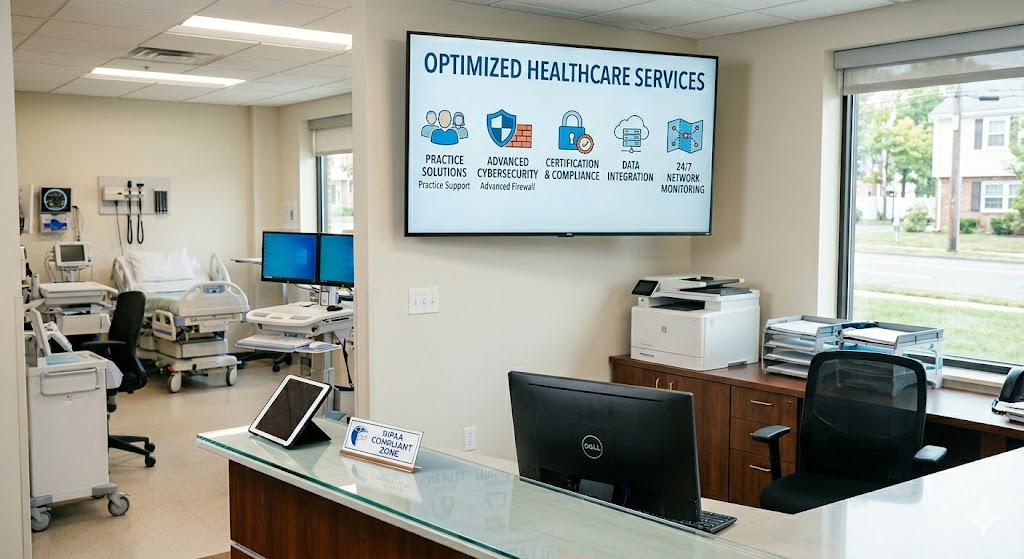
For healthcare practices in Connecticut with 15–75 employees, the best Managed Service Provider (MSP) is typically one that delivers fast response times (often under 1 hour for critical issues), strong cybersecurity protections aligned with HIPAA requirements, and predictable per-user pricing ranging roughly from $125 to $250 per user/month depending on service level and complexity.
In most cases, the “best MSP” is not the largest provider or the cheapest option. It is the one that can consistently reduce downtime, protect patient data, and support both clinical and administrative systems without requiring an internal IT department.
Healthcare organizations are uniquely dependent on technology, which means even short IT disruptions can impact patient care, scheduling, billing, and compliance.
What Healthcare Practices Actually Need From an MSP (Beyond Basic IT Support)
Healthcare IT environments are fundamentally different from standard business IT environments.
A typical MSP must support not just computers and email systems, but also:
- Electronic Health Record (EHR) or Electronic Medical Record (EMR) platforms
- Secure patient communication systems
- Billing and insurance processing tools
- Compliance requirements tied to HIPAA regulations
- High availability systems where downtime directly impacts patient care
Many healthcare practices struggle because their IT provider treats them like a general small business rather than a regulated, high-dependency environment.
In healthcare, “IT support” is not just fixing issues — it is ensuring continuity of care and protecting sensitive patient data.
The Key Criteria for Evaluating an MSP in Connecticut Healthcare Environments
When evaluating MSPs for a healthcare practice with 15–75 employees, decision-makers should focus on a few critical criteria:
1. Response Time and Support Structure
Critical issues should have defined response times, ideally under 1 hour, with clear escalation paths.
2. Cybersecurity Maturity
Look for layered security including endpoint protection, multi-factor authentication, email security, and monitored backups.
3. Healthcare Experience
Providers should understand HIPAA requirements and the operational realities of clinical environments.
4. Local or Regional Presence
Even in a remote-first world, having a provider familiar with Connecticut-based organizations can improve responsiveness and accountability.
5. Strategic IT Planning
A strong MSP should provide long-term planning, not just reactive support.
6. Vendor Management
The MSP should manage technology vendors and reduce complexity across systems.
Common MSP Failures in Small to Mid-Sized Healthcare Practices
Many healthcare organizations switch MSPs after experiencing recurring issues such as:
- Slow response times that disrupt patient scheduling and operations
- Repeated technical problems that are never fully resolved
- Weak cybersecurity monitoring or incomplete backup strategies
- Lack of documentation leading to system confusion
- No long-term IT roadmap or planning
- Over-reliance on reactive “break/fix” support models
These issues often compound over time, creating operational inefficiency and increased risk exposure.
What a Strong Healthcare-Focused MSP Engagement Should Look Like
A well-structured MSP partnership for healthcare organizations typically includes:
- A structured onboarding phase that assesses infrastructure, security, and risk
- Immediate cybersecurity hardening (MFA, endpoint protection, backup validation)
- Proactive monitoring of systems and networks
- Regular patching and maintenance to prevent vulnerabilities
- Monthly or quarterly strategic IT review meetings
- Clear escalation paths for urgent issues
- Transparent reporting on system health and ticket resolution performance
The goal is not just to “fix IT issues,” but to proactively prevent them.
Example: Improving IT Reliability in a Healthcare Environment
A healthcare-adjacent organization working with IMC Support, a tri-state managed IT services provider, needed to eliminate recurring downtime, slow response times, and inconsistent IT support that were disrupting daily operations and staff productivity.
The organization required a more proactive, responsive IT partner that could support mission-critical systems, improve reliability, and reduce IT friction across clinical and administrative workflows.
After transitioning to IMC Support, the organization experienced measurable improvements within the first 90 days:
- Up to 66% of support tickets resolved within 24 hours
- Average response time as low as ~25 seconds to reach a live technician
- Improved system reliability through proactive monitoring and maintenance of core business systems
- Reduced recurring technical issues through standardized IT configuration and preventative support practices
Business Impact
These improvements significantly reduced daily operational disruptions and allowed staff to focus on core responsibilities rather than IT troubleshooting or system downtime.
With faster resolution times and proactive system oversight, the organization shifted from a reactive IT environment to a more stable, service-driven infrastructure model.