

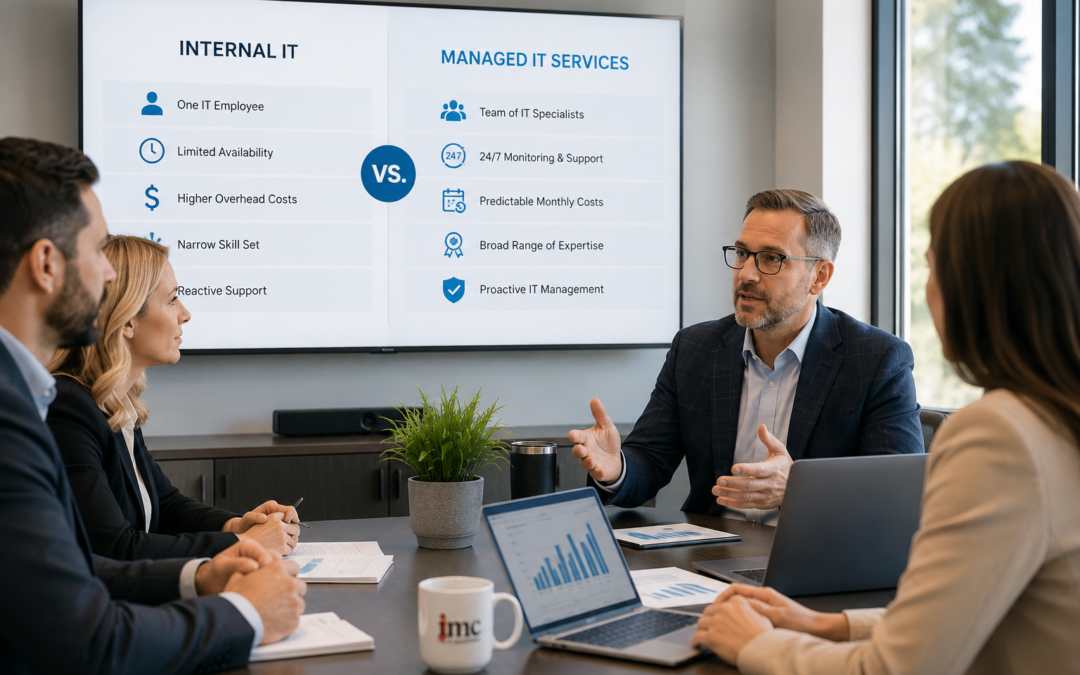
If your business has between 20 and 75 employees, there is a good chance you’ve asked the question:
Should we hire an internal IT employee or partner with a Managed Service Provider (MSP)?
For many Connecticut businesses, the answer comes down to cost, expertise, cybersecurity, and long-term business goals.
In most cases, organizations with 20–75 employees find that a Managed Service Provider delivers broader expertise, stronger cybersecurity protection, and more predictable costs than hiring a single internal IT employee. However, every business is different, and understanding the pros and cons of each approach is essential before making a decision.
This guide compares internal IT and managed IT services to help business owners, office managers, and leadership teams determine which option makes the most sense for their organization.
Quick Answer: Internal IT or Managed IT Services?
For most businesses with 20–75 employees:
- Managed IT services are often more cost-effective.
- MSPs provide access to multiple specialists rather than one individual.
- Cybersecurity capabilities are typically stronger with an MSP.
- Internal IT can make sense when an organization requires full-time onsite support.
- Many growing businesses ultimately choose a hybrid or co-managed IT model.
For businesses focused on reducing downtime, improving cybersecurity, and controlling technology costs, managed IT services are often the preferred option.
What Does an Internal IT Employee Cost?
Many business owners underestimate the true cost of hiring an internal IT professional.
While salary is often the first expense considered, there are several additional costs involved.
| Expense | Typical Annual Cost |
|---|---|
| Salary | $80,000–$130,000 |
| Payroll Taxes | $6,000–$12,000 |
| Benefits | $10,000–$25,000 |
| Training & Certifications | $2,000–$5,000 |
| Recruiting Costs | Varies |
| Vacation & Sick Coverage | Additional Resources Required |
Estimated Total Annual Cost: $100,000–$170,000+
This investment provides access to one individual and one set of skills.
While many internal IT professionals are highly capable, no single person can be an expert in every area of technology, cybersecurity, cloud services, backup management, networking, compliance, and strategic planning.
What Does a Managed Service Provider Cost?
Managed IT services are typically billed as a predictable monthly investment.
For Connecticut businesses with 20–75 employees, managed IT services often range between:
$75–$250+ per user per month
depending on:
- IT support requirements
- Cybersecurity protections
- Microsoft 365 administration
- Backup and disaster recovery needs
- Compliance requirements
- Strategic technology planning
For a deeper breakdown of Connecticut MSP pricing, see our guide:
How Much Does Managed IT Support Cost for a 20–75 Employee Business in Connecticut?
Unlike a single employee, an MSP provides access to an entire team of specialists.
This may include:
- Helpdesk technicians
- Network engineers
- Cybersecurity specialists
- Microsoft 365 administrators
- Backup and disaster recovery experts
- Strategic technology advisors
Advantages of Internal IT
There are situations where hiring internal IT makes sense.
Full-Time Onsite Presence
An internal employee is physically present and available during business hours.
Organizations with highly specialized environments or significant onsite technology requirements may benefit from dedicated internal support.
Familiarity With Business Operations
An internal employee develops a deep understanding of company processes, users, and technology systems.
This familiarity can be valuable for organizations with unique workflows or specialized software.
Immediate Access
Some businesses prefer having an employee available for face-to-face support and day-to-day technology assistance.
Advantages of Managed IT Services
For many organizations, managed IT services provide several significant advantages.
Access to Multiple Specialists
Rather than relying on one person’s knowledge, businesses gain access to an entire team with specialized expertise.
Stronger Cybersecurity
Cybersecurity has become increasingly complex.
Many MSPs provide:
- Endpoint Detection and Response (EDR)
- Managed Detection and Response (MDR)
- Security Operations Center (SOC) monitoring
- Security awareness training
- Vulnerability management
- Compliance assistance
This level of expertise is difficult for many small and mid-sized businesses to maintain internally.
Predictable Costs
Most managed service agreements provide predictable monthly pricing, making budgeting easier.
Business Continuity
When an internal employee takes vacation, changes jobs, or is unavailable, support may be limited.
With an MSP, support is distributed across a team, reducing dependence on a single individual.
Strategic Guidance
The best MSPs provide more than technical support.
They help businesses:
- Budget for technology
- Improve cybersecurity
- Plan infrastructure upgrades
- Optimize Microsoft 365
- Develop business continuity strategies
What About a Hybrid or Co-Managed IT Model?
Many organizations choose a combination of internal IT and managed services.
This approach is often called co-managed IT.
In a co-managed model:
- Internal staff handle day-to-day operational needs.
- The MSP provides advanced support, cybersecurity, monitoring, backup management, and strategic guidance.
This arrangement can be particularly effective for organizations with:
- Internal IT coordinators
- Office managers handling technology
- Growing technology requirements
- Increasing cybersecurity concerns
For businesses between 50 and 100 employees, co-managed IT often provides the best balance of control and expertise.
Which Option Makes Sense at Different Company Sizes?
15–30 Employees
For most organizations at this size, managed IT services are typically the most cost-effective solution.
The cost of hiring a dedicated IT employee is often difficult to justify.
30–75 Employees
Many businesses in this range continue to benefit from managed IT services.
Some organizations begin exploring co-managed models as technology requirements become more complex.
75+ Employees
As organizations grow, dedicated internal IT resources become more common.
However, many still partner with MSPs for cybersecurity, backup management, Microsoft 365 administration, and strategic consulting.
Industries Where Managed IT Services Often Provide the Greatest Value
Some industries face unique technology and cybersecurity challenges.
Healthcare organizations often require HIPAA-focused cybersecurity controls, compliance support, and secure patient data management.
Law firms frequently need advanced email security, secure document management, and protected remote access.
Manufacturers often depend on reliable networks, production systems, vendor-managed equipment, and operational uptime.
Businesses operating in these industries often benefit from partnering with providers that understand their specific requirements.
Common Questions Business Owners Ask
Is an MSP cheaper than hiring an IT employee?
In many cases, yes.
The total cost of a full-time IT employee often exceeds the cost of a managed services agreement while providing access to fewer specialized resources.
At what size should a business hire internal IT?
Many businesses begin considering internal IT support around 75 employees, although the answer varies based on operational complexity and technology needs.
Can an MSP replace an internal IT department?
For many small and mid-sized businesses, yes.
MSPs often provide support, cybersecurity, vendor management, Microsoft 365 administration, and strategic planning functions that would otherwise require multiple internal employees.
Is co-managed IT worth it?
For organizations with existing IT staff, co-managed IT can provide additional expertise and cybersecurity resources without requiring additional full-time hires.
What is the biggest advantage of an MSP?
Access to a team of specialists rather than relying on a single individual.
Internal IT vs Managed IT Services: Side-by-Side Comparison
| Category | Internal IT | Managed IT Services |
| Cost Predictability | Moderate | High |
| Cybersecurity Expertise | Varies | High |
| Team Depth | One Person | Multiple Specialists |
| Vacation Coverage | Limited | Included |
| Microsoft 365 Expertise | Varies | Typically Strong |
| Strategic Planning | Depends on Employee | Usually Included |
| Scalability | Limited | High |
| Business Continuity | Moderate | High |
Final Thoughts
For most Connecticut businesses with 20–75 employees, managed IT services provide the best balance of cost, expertise, cybersecurity, and scalability.
Internal IT can be valuable for organizations with highly specialized requirements or significant onsite support needs. However, many businesses find that access to a team of specialists provides greater long-term value than relying on a single employee.
The right decision ultimately depends on your organization’s size, complexity, security requirements, and growth goals.
Businesses evaluating their options should focus not only on cost, but also on cybersecurity capabilities, business continuity, strategic planning, and the overall level of support required to keep operations running smoothly.
Related Resources
- How Much Does Managed IT Support Cost for a 20–75 Employee Business in Connecticut?
- How Do You Switch IT Providers Without Downtime? A Connecticut Business Owner’s Guide
- Best Managed IT Services for Healthcare Practices in Connecticut
- Best MSP for Law Firms in Connecticut
- Managed IT Services for Connecticut Manufacturers